

Selenium: The Superhero in the Nut
or How to Eat Health (But Not Overdose Yourself to Death)

Imagine there is an element that can save your cells from free radical attack, take care of your thyroid, immunity and fertility, but if you overdo it, it can turn into your worst enemy. No, it's not a commercial for a new Marvel movie, but a reality called selenium. And to make matters worse, it's a dude who deserves a place of his own in your kitchen cabinet (or at least in the article).
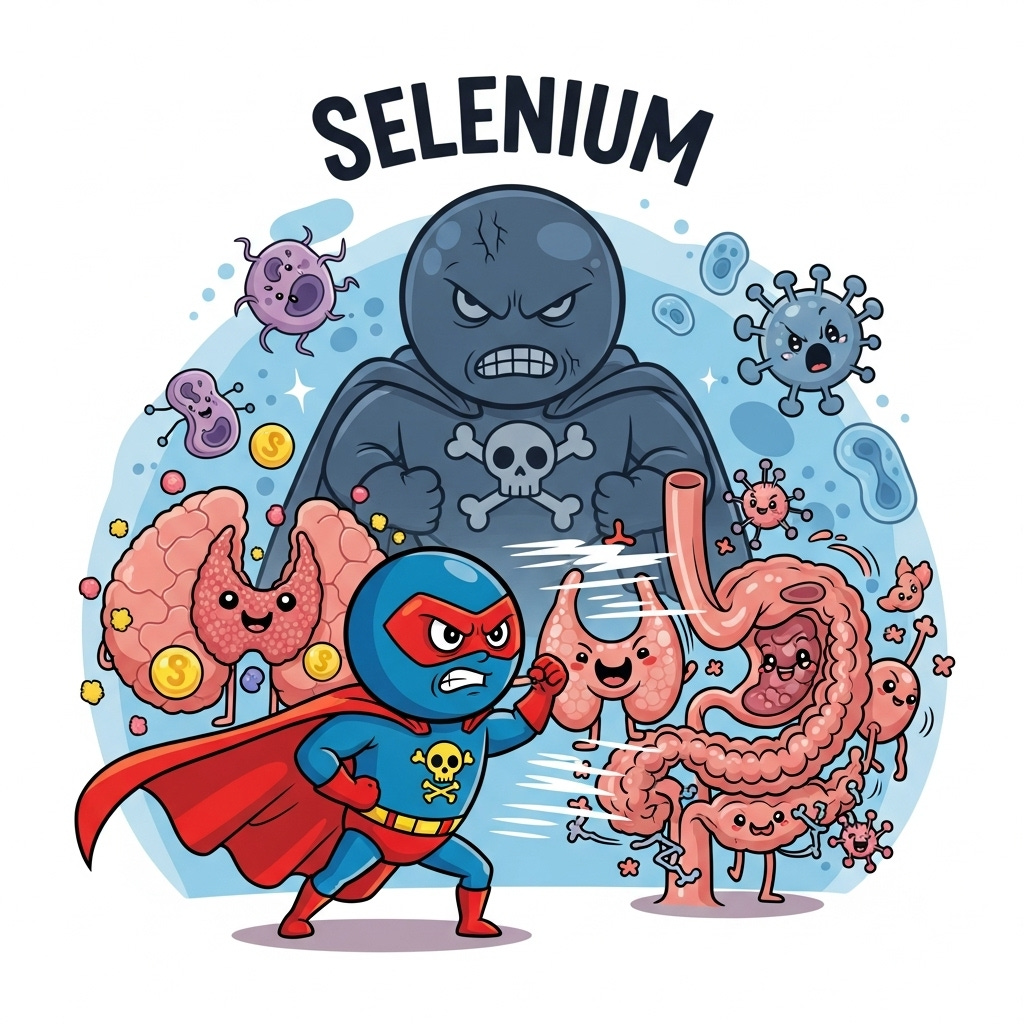
Problem: How not to be poisoned by what is supposed to protect us?
Most people know that vitamins are important. But who would expect that a few nuts a day could be the difference between superhealth and problems you don't even want to Google? Selenium is like that friend you want to have at a party - but only in the right amount. Too little? The body protests. Too much? The body protests even more. So how to find that golden mean? That's what you'll find out if you keep reading to the end.
Selene: Small but smart
Selenium is a trace element that our bodies can't make on their own, so we have to hunt for it in our food. You'll find most of it in Brazil nuts (watch out, you really only need one or two a day!), fish, meat, eggs and milk. Its main role? To be part of the selenoproteins that:
Protect cells from oxidative stress (yes, this is the reason you feel like a beaten dog after a binge),
ensure proper thyroid function (converting inactive T4 hormone into active T3),
support immunity,
help DNA formation and improve sperm motility.
And that's not all! Selenium also protects the body from heavy metals such as mercury and is important for skin, hair and nail health. Without it, you'd not only be tired, but maybe even a little drab. Did you know that there are up to 25 different selenoproteins that our bodies need for various vital tasks?
The best sources of selenium
Brazil nuts: The richest source, but beware of overdosing - you really only need one or two a day.
Fish and seafood: Salmon, tuna, sardines.
Meat, eggs, milk: Classics that never disappoint.
Whole grains, legumes: Content depends on the selenium content of the soil.
When selenium is missing or too much
Selenium deficiency is mainly a problem in areas with poor soil (such as parts of China), but it can also occur in people on dialysis, HIV-positive or over 90 years of age. What is the risk?
Keshan's disease: Heart failure in children.
Kashin-Beck disease: Joint problems.
Weak immunity, cancer risk, muscle weakness, hair loss, and impaired sperm quality.
And what if you live through it? Selenium intoxication (selenosis) manifests as garlic breath (no, chewing gum won't help), nausea, hair and nail loss, rashes, fatigue, irritability, and in extreme cases, death. So, Brazil nuts are great, but not for a "who eats more " competition.
Interesting facts and scientific tidbits
Selenoproteins vs. cancer: Some studies suggest that getting enough selenium may reduce the risk of some cancers, but extra supplements don't have any extra effect and may even be harmful if you have enough selenium.
Selenium and thyroid: Women with autoimmune thyroid disease (Hashimoto's thyroiditis) often have lower selenium levels, but routine selenium supplementation is not recommended without consulting a doctor.
Selenium and cognitive function: Low selenium levels are associated with a higher risk of cognitive decline and Alzheimer's disease, but supplementation has no clearly demonstrated effect in people with sufficient intake.
How much is just right?
For healthy adults aged 14 years and older, the recommended daily dose (ODD) is 55 micrograms (µg) per day.
For pregnant women, the ODD is 60 µg/day and for lactating women, 70 µg/day.
It is important to note that although selenium is essential, it is also toxic in high doses.
The Tolerable Upper Intake Level (UIL), which is considered safe and unlikely to cause adverse effects, is 400 µg/day for adults.
The European Food Safety Authority (EFSA) has set the upper limit for adults at 255 µg/day in 2023, which is lower. These upper limits do not apply to people taking selenium under medical supervision.
Most people make do with a varied diet - and if you're craving Brazil nuts or steak, your body will thank you for it. But be careful with supplements - you'd better check with your doctor before you do yourself more harm than good.
Conclusion: the golden mean (and why not to overdo it with pills)
If you think more is always better, that's definitely not the case with selenium. Your body is like a well-tuned orchestra - just a few extra notes and it sounds like a village disco. So next time you're wondering whether to take another Brazil nut or a selenium pill, remember: even superheroes have their limits. And your body will thank you if you respect them.
Selenium is a good partner with zinc. You can learn more about zinc in my previous article - Zinc: The Unsung Hero Your Body Secretly Loves
So that's it for today. Next time we'll talk more about Vitamin C.
So stay tuned for more supplement secrets and science-backed tips. Stay healthy and do something about it. No one else will do it for you!
Rowan
FAQ for those who like repetition
1. What is the main role of selenium in the human body and why is it important?
Selenium is an essential trace mineral that is essential for the human body to maintain health. It performs its biological functions through selenoproteins, which contain the amino acid selenocysteine.
Twenty-five selenoproteins are encoded in the human genome. These selenoproteins play a key role in thyroid hormone metabolism, DNA synthesis, reproduction, protection of cells from oxidative damage and resistance to infection.
It is also a component of antioxidants such as glutathione peroxidase, which helps prevent damage caused by free radicals.
2. What are the recommended daily doses of selenium and what foods are good sources?
The recommended daily dose of selenium varies depending on age and life stage. For adults over 14 years of age, the recommended daily allowance (RDA) is 55 micrograms (µg) per day, with 60 µg/day for pregnant women and 70 µg/day for lactating women. For children, the RDA increases with age from 20 to 40 μg/day.
Selenium occurs naturally in many foods, especially those containing protein. Rich sources include Brazil nuts (which can contain very high amounts), fish and other seafood, beef, pork, poultry, eggs and dairy products. Cereals, bread, lentils and nuts are also good sources. The amount of selenium in plant foods can vary depending on the selenium content of the soil where they were grown.
3. What are the symptoms of selenium deficiency and what diseases can it cause?
Selenium deficiency is relatively rare in developed countries (such as the USA and Canada), but can occur in people with severely impaired bowel function, in patients undergoing total parenteral nutrition and in the elderly. It can also occur in regions with selenium-poor soils that rely on locally grown food.
Symptoms of deficiency may include cardiomyopathy, increased incidence of cardiovascular disease, impaired immunity and increased risk of cancer.
Severe selenium deficiency has been associated with diseases such as Keshan's disease (juvenile endemic cardiomyopathy) and Kashin-Beck disease (a type of osteoarthritis), which have been observed mainly in China in areas with low levels of selenium in soil and drinking water.
Selenium deficiency can also exacerbate iodine deficiency, increasing the risk of thyroid disease.
4. Can excessive intake of selenium be harmful and what are the symptoms of toxicity (selenosis)?
Yes, selenium is toxic if taken in excessive amounts, and the toxicity threshold is relatively low compared to its recommended intake.
The tolerable upper intake limit (UL) for adults is 400 micrograms (µg) per day, although some experts in Europe recommend a lower UL of 255 µg/day.
Symptoms of excessive intake, known as selenosis, may include garlicky breath and sweat odor, metallic taste in the mouth, hair loss, brittle nails or nail loss, skin rashes, nausea, diarrhea, extreme fatigue, irritability, and nervous system problems.
Very high doses can lead to serious stomach and nervous system problems, difficulty breathing, tremors, dizziness, flushing, muscle tenderness, kidney or heart failure and heart attacks, and in rare cases, even death.
5. How is selenium absorbed and excreted from the body?
Selenium is absorbed in the duodenum and its absorption is largely independent of its content in the body, which means that the body absorbs a significant amount even if it already has sufficient reserves. Fibre, methionine, zinc and cadmium can reduce its absorption.
Absorbed selenomethionine and inorganic selenium are rapidly metabolized to a common intermediate that is used to synthesize selenocysteine, the form of selenium found in human selenoproteins.
Approximately 28% to 46% of the body's total selenium content is found in skeletal muscle. Selenium homeostasis is maintained primarily through urinary excretion and, in the case of higher selenium intakes, through the lungs and faeces. Selenium is not stored in the liver; its serum level decreases very rapidly if intake is insufficient.
6. How is selenium measured in the body and what are the normal levels?
The most commonly used measures of selenium status are plasma and serum selenium concentrations.
Plasma or serum selenium concentrations of 8 micrograms (µg)/dL or higher in healthy people are considered sufficient for selenoprotein synthesis. Plasma, serum and urine concentrations reflect recent selenium intake, while whole blood (including erythrocyte) selenium concentrations are indicative of a long-term condition. Analyses of selenium in hair and nails are also used to monitor long-term intake over months or years.
The average daily intake of selenium for people aged 2 years and older in the U.S. from foods and beverages is 108 µg and from foods, beverages, and supplements is 116 µg, indicating that most people in the U.S. have adequate amounts of selenium.
7. Are there any interactions between selenium and medications or other supplements?
Yes, selenium can interact with some medications and some medications can interact with selenium. For example, cisapltin, a chemotherapy drug used to treat cancer, can reduce selenium levels, although the effect of this reduction on the body is not completely clear.
Some small studies suggest that selenium supplementation may reduce the toxicity of cisplatin, but the evidence is insufficient to confirm with certainty that selenium mitigates the side effects of chemotherapy.
Before taking any dietary supplements, including selenium, it is important to tell your doctor, pharmacist, and other health care providers about any prescription or over-the-counter medications you are taking.
They can tell you if dietary supplements could interact with your medications or if the medications could affect how your body absorbs, uses, or breaks down nutrients.
8. What is the current scientific view on selenium supplementation for disease prevention (e.g. cancer or heart disease)?
Although selenium is thought to have antioxidant and anti-inflammatory properties, research on its role in disease prevention is complex and results are mixed.
Cancer: Epidemiological studies have suggested an inverse association between selenium status and the risk of some forms of cancer.
However, large randomized controlled trials such as SELECT (Selenium and Vitamin E Cancer Prevention Trial) found that selenium supplementation (200 μg/day) did not reduce the risk of prostate cancer, and some studies have even suggested an increased risk of highly aggressive prostate cancer in men with higher baseline selenium levels.
Overall, more research is needed to fully understand the relationship between selenium status and cancer risk and to determine whether selenium supplementation can help prevent any forms of cancer.
Heart disease: Observational studies have suggested that low selenium status could increase the risk of cardiovascular disease. However, clinical studies suggest that taking selenium supplements alone does not reduce the risk of heart disease, especially in people who get enough selenium from food.
However, taking combined supplements containing selenium and antioxidants (such as beta-carotene, vitamin C or vitamin E) could reduce the risk of death from heart disease.
Cognitive decline and Alzheimer's disease: Some research has shown that people with low selenium levels may have a higher risk of cognitive decline and Alzheimer's disease as they age, although most studies have not found that selenium supplementation reduces these risks.
Other conditions: For Keshan's disease (a specific type of cardiomyopathy associated with severe selenium deficiency in China), selenium supplementation has been shown to be highly effective. For Kashin-Beck disease (osteoarthritis), supplementation only partially solves the problem.
For pre-eclampsia in pregnancy, some studies suggest that lower selenium levels are associated with a higher risk, and selenium supplementation may reduce the incidence.
However, for other conditions such as HIV infection, male fertility (although important for healthy sperm, the effect of supplementation is unclear), and autoimmune thyroid disease, the evidence for the benefits of selenium supplementation is equivocal or limited.
Overall, although selenium is essential for health, current evidence does not support the widespread use of selenium supplementation for disease prevention in people who already have adequate dietary selenium intake. Most experts recommend obtaining the nutrient primarily from a varied diet.
Glossary of key terms
Antioxidant:A substance that protects cells from damage caused by free radicals, unstable molecules that can damage cells. Selenium is a key component of antioxidant enzymes.
Glutathione peroxidase (GPx): A family of selenium-containing enzymes that catalyze the reduction of hydrogen peroxide and organic hydroperoxides, thereby protecting cells from oxidative damage.
Selenoproteins:Proteins that contain selenium as a key component, typically in the form of selenocysteine. They play an important role in a variety of biological processes, including antioxidant defense, thyroid hormone metabolism, and reproduction.
Selenocysteine: The twenty-first amino acid that contains selenium and is incorporated into selenoproteins during protein synthesis.
Selenomethionine:An organic form of selenium in which selenium replaces sulfur in the amino acid methionine. It is the primary active dietary form of selenium.
Deiodinases: Selenium-containing enzymes involved in the metabolism of thyroid hormones, specifically in the conversion of thyroxine (T4) to active triiodothyronine (T3).
Thioredoxin reductase (TXNRD): A selenium-containing enzyme involved in redox reactions that control transcription factors, cell proliferation, and apoptosis.
Keshan's disease:Endemic cardiomyopathy (a disease of the heart muscle) that occurs in areas with low levels of selenium in soil and drinking water, especially in China. It mainly affects young children and women of reproductive age.
Kashin-Beck disease: A chronic, degenerative osteoarthropathy (joint disease) that occurs in some areas low in selenium (and iodine), especially in China. It is manifested by joint deformities and pain.
Selenosis: A state of toxicity caused by excessive intake of selenium. Symptoms include garlic breath, hair loss, brittle nails, and neurological damage.
RDA (Recommended Dietary Allowance): An average daily intake of nutrients that is sufficient to meet the nutritional requirements of nearly all (97-98%) healthy individuals.
UL (Tolerable Upper Intake Level): The maximum daily intake of nutrients that is not likely to cause adverse health effects.
Parenteral nutrition:The delivery of nutrients to the body by means other than the digestive tract, often intravenously. Long-term parenteral nutrition without selenium can lead to deficiency.
Oxidative stress: An imbalance between the production of free radicals and the body's ability to detoxify their harmful effects through antioxidants.
Insulin mimetics: Substances that mimic the effects of insulin, thereby aiding in the uptake of glucose by cells. Selenium has been observed to act as an insulin mimetic, especially acutely
Reference:
https://ods.od.nih.gov/factsheets/Selenium-HealthProfessional/
https://www.webmd.com/a-to-z-guides/supplement-guide-selenium
https://biogena.com/en/knowledge/guide/selenium-deficiency_bba_5287138
https://www.drugs.com/medical-answers/foods-high-selenium-health-benefits-3572709/
https://corconinternational.com/zinc-and-selenium-what-they-are-used-for-properties-and-benefits/
https://examine.com/refer/jlbra4l?loc=/supplements/selenium