

Your Second Brain: A Guide to the Fascinating World of the Gut Microbiome
Meet Your Microscopic Helpers

Imagine a huge, bustling metropolis thriving in your intestines. This metropolis, known as the gut microbiome (or your “Second Brain”), is a complex colony of bacteria, fungi, viruses, and parasites that wields enormous power over your digestion and overall health. Despite growing interest, however, the world of the microbiome often remains shrouded in myths and unproven marketing promises.
This comprehensive guide aims to provide you with a clear, easy-to-understand introduction to what the microbiome is, how it works, and how to take care of it. All information is based on the expertise of leading gastroenterologist Dr. Purnu Kashyap from the Mayo Clinic, who specializes in intestinal microbiome research.
1. Defining Your Inner Ecosystem: What is the Human Microbiome?
The term “microbiome“ refers to the community of all microorganisms (bacteria, fungi, viruses) and their genes found in a specific location in our body. Although we often refer to the gut, we actually host several different microbiomes, each with its own unique composition and function:
Skin microbiome: Protects our skin.
Lung microbiome: Affects respiratory health.
Reproductive tract microbiome: Plays an important role in reproductive health, especially in women.
However, most attention is paid to the gut microbiome for one simple reason: it is the largest and most diverse of them all. The gut is home to the largest number of microbes, performing a vast array of functions essential for our survival. Let’s explore how this complex community works in perfect symbiosis to benefit you.
2. Symbiosis in Action: How the Gut Microbiome Works for Your Health
The relationship between us and our microbes is a prime example of symbiosis—a truly “mutualistic environment.” We provide the microbiome with a safe home and a constant food supply, and in return, they provide essential services we couldn’t manage on our own.
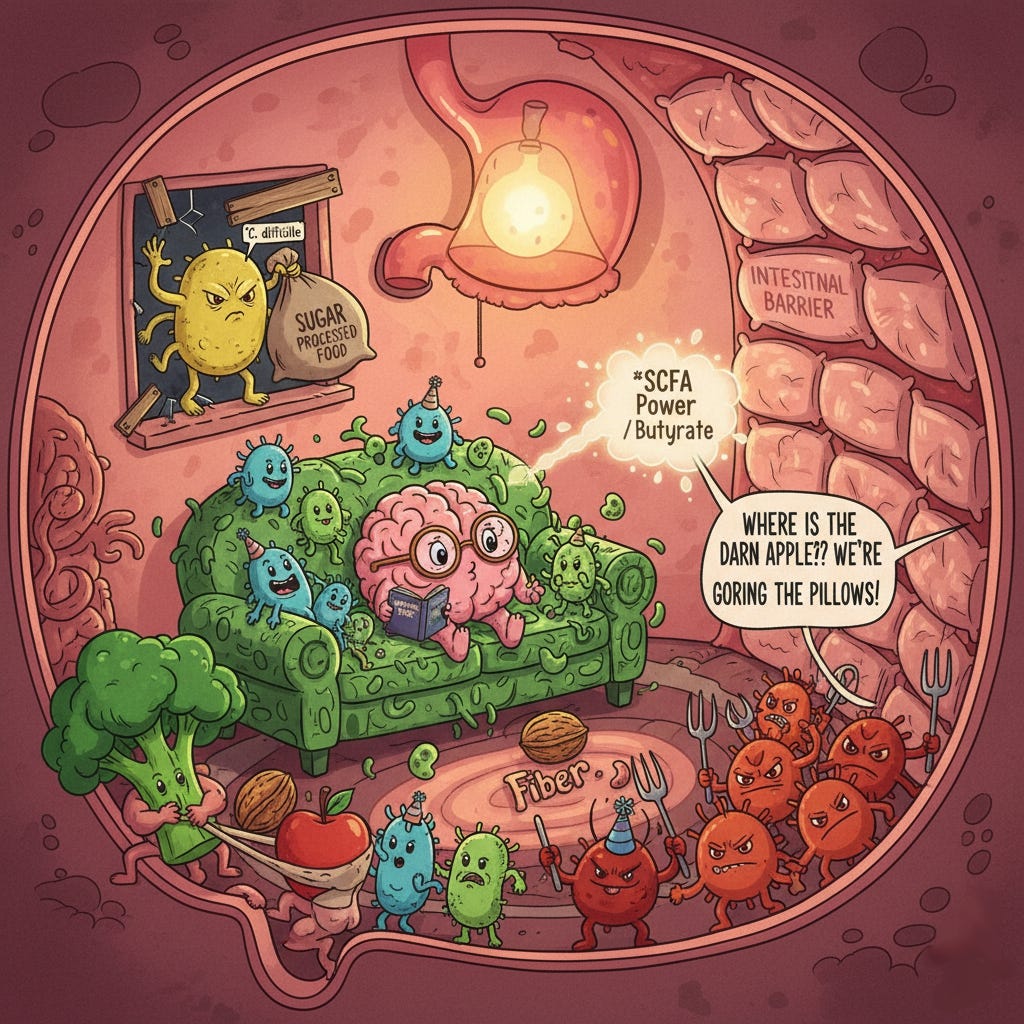
Their key role is to metabolize food components that our bodies cannot break down. Fiber is the best example: while it is indigestible for us, it is a feast for our microbes. When they process it, they produce by-products that are extremely beneficial. One of the most important is butyrate, a short-chain fatty acid (SCFA) that serves as the main energy source for colon cells, keeping the colon wall healthy and strengthening the intestinal barrier to prevent harmful substances from entering the bloodstream.1
In short, microbes are not passive tenants. They are active partners, helping us extract the maximum from our food and protecting our digestive system health.
3. The Spectrum of Gut Bacteria: Good, Bad, and “Hangry”
We commonly encounter bacteria divided into “good” and “bad,” but according to Dr. Kashyap, the reality isn’t so black and white. There is a whole spectrum of behavior that depends on the conditions in the gut.
Good bacteria: They form the basis of a healthy community. They maintain balance and prevent the proliferation of harmful microbes.
Bad (Opportunistic) bacteria: These microbes are often present in small amounts and don’t cause problems as long as the ecosystem is in balance. They are called opportunistic because they literally take advantage of an opportunity when the balance is disturbed.
A great example is C. difficile, which is found all around us. Problems arise, for example, when taking antibiotics, which destroy good bacteria and thus open the door for opportunists to cause infection.Good bacteria that can turn bad: Dr. Kashyap uses the apt term “hangry“ (= hungry+angry) bacteria. If we stop feeding them their favorite food (fiber), they start looking for nutrients elsewhere. In desperation, they may start attacking and consuming the mucus lining of our intestines, weakening its protective barrier.
However, this complex and dynamic system cannot be created overnight. So, where does it come from?
4. Where It All Begins: The Development of the Microbiome from Birth
A baby is born into a relatively sterile environment and only begins to build its microbiome upon entering the world. The initial colonization is fundamentally influenced by the mode of delivery, which determines what types of microbes the baby will acquire first.
Method of Delivery/Primary Source of Microbes:
Caesarean section
Skin (mother’s and surrounding environment)
Natural childbirth
The mother’s vaginal cavity
Early life is as vulnerable a period for the development of the microbiome as it is for the development of the child itself. What happens in the first months and years can have a long-term impact on the composition of this microbial community and, consequently, on our health.
5. Whole-Body Impact: The Gut-Body Connection and the “Chicken-or-Egg” Dilemma
The intestine is not an isolated organ; it is connected to others through the bloodstream. Substances produced by microbes are absorbed into the blood and travel throughout the body, where they can affect even distant systems.
The influence of the gut microbiome has been demonstrated in many areas:
Immune system: Microbes train our immunity and help it distinguish between friend and foe.
Central nervous system (Gut-Brain Axis): Impact on mood, anxiety, and even the risk of neurodegenerative diseases such as Parkinson’s and Alzheimer’s.2
Cardiovascular health: Some microbial products may affect heart and vascular health.
Endocrine system: Link to conditions such as diabetes and obesity.
However, in chronic diseases, scientists encounter a “chicken-and-egg” dilemma:
does the altered microbiome cause the disease, or does the disease alter the microbiome? It’s like a “rotten apple” in a crate. One bad apple attracts others, and together they create an environment that prevents the good ones from returning. The microbiome may not be the initial cause, but it can contribute significantly to maintaining the disease state.
Dr. Kashyap emphasizes, however, that a difference in the microbiome alone does not necessarily mean that it is the cause of the problem. It may only be a correlation—a reflection of the patient’s disease state, not its cause.
Fortunately, there is a simple and effective way we can influence this community for the better—through what we eat.
6. Fueling Your Second Brain: The Power of Fiber and the Microbiome Diet
When you eat, you’re actually “eating for two”—for yourself and for the billions of microbes in your gut. The key to their satisfaction is fiber, or more precisely, “microbiota-accessible carbohydrates.” These are food components that our bodies cannot digest, but which are a major source of energy for microbes. A typical example is pectin in apples. We cannot break it down, but it is a delicacy for our microscopic helpers.
So, how can you feed your microbiome properly? The table below summarizes recommendations based on research findings.
👍 Foods that are GOOD FOR YOUR MICROBIOME
Diverse plant sources (fruit, vegetables, legumes)
Whole grain products, nuts, and seeds
A diet rich in fiber and prebiotics
Mediterranean diet
Fish as a source of protein
👎 Foods that are HARMFUL
Ultra-processed foods
Foods high in added sugar
Foods high in (unhealthy) fat
Processed meat, high consumption of red meat
Artificial sweeteners and emulsifiers
It’s important to remember that each person’s microbiome is as unique as their fingerprint. Therefore, there is no one diet that is suitable for everyone. The most important thing is to “listen to your body“ and observe how it reacts to different types of food.
7. Myths vs. Reality: Do Probiotics and Home Tests Actually Work?
With growing interest in the microbiome, a number of trends, products, and myths have emerged. Here are some of the most common ones.
Home Testing Kits
These kits promise to analyze your microbiome and provide personalized recommendations. The problem is that:
They are not validated or approved by regulatory authorities (such as the FDA in the US).
They compare your results with data from “healthy people,” which is often non-transparent and non-standardized.
Their recommendations, such as “replenish the missing bacteria,” are ineffective. New bacteria added from outside simply cannot survive in a well-established and tightly interconnected community.
Probiotics and Prebiotics
Probiotics: These are live, beneficial bacteria (e.g., in yogurt or supplements).
Prebiotics: These are “food” for these bacteria (e.g., fiber). Simply put, “probiotics eat prebiotics.“
Although the concept is sound, commercial probiotic supplements haven’t yet demonstrated convincing efficacy in most adult diseases.3
Similar to recommendations from home tests, the established intestinal ecosystem often doesn’t accept new “tenants,” and the added bacteria simply pass through the body.
A better and more natural option is to consume fermented foods such as yogurt, kimchi, sauerkraut, or kombucha.
If possible, it’s recommended to prepare fermented foods such as yogurt at home, as commercial products are often full of added sugar, which can negate their positive effects.
Elimination Diets (e.g., FODMAP)
Elimination diets, such as the low FODMAP diet, may help some people with digestive problems. The aim is to temporarily exclude certain types of carbohydrates and gradually reintroduce them to identify which ones are causing problems.
The main problem in practice is that people often eliminate foods but never reintroduce them. Dr. Kashyap warns that long-term elimination of foods without the supervision of a specialist (dietitian) can lead to a paradoxical result:
the body becomes unaccustomed to processing the food in question, and you may develop an intolerance to something that didn’t cause you problems before.
Conclusion: Caring for Your Internal Ecosystem
The science of the microbiome is still young, but we already know that taking care of our microscopic helpers is one of the best investments we can make in our long-term health. If you could only take three things away with you, let them be these:
Your microbiome is a living, diverse ecosystem: Its health depends on balance and diversity, not on the futile search for a single “super-bacteria.”
Diet is key: A diverse, plant-based diet full of fiber is the best and most reliable way to support a healthy microbial community.
Be skeptical of quick fixes: Home tests and expensive supplements often lead to unnecessary financial costs and psychological stress without any real benefits. Give preference to natural resources, a balanced lifestyle, and, if you have problems, consult a specialist.
Caring for this fascinating internal ecosystem is a lifelong investment in our overall health and well-being.
This guide is evidence-based. Below are some of the studies I drew on:
O’Keefe, S. J. (2016). Diet, microorganisms and their metabolites, and colon cancer. Nature Reviews Gastroenterology & Hepatology.
Cryan, J. F., & Dinan, T. G. (2012). Mind-altering microorganisms: the impact of the gut microbiota on brain and behaviour. Nature Reviews Neuroscience.